
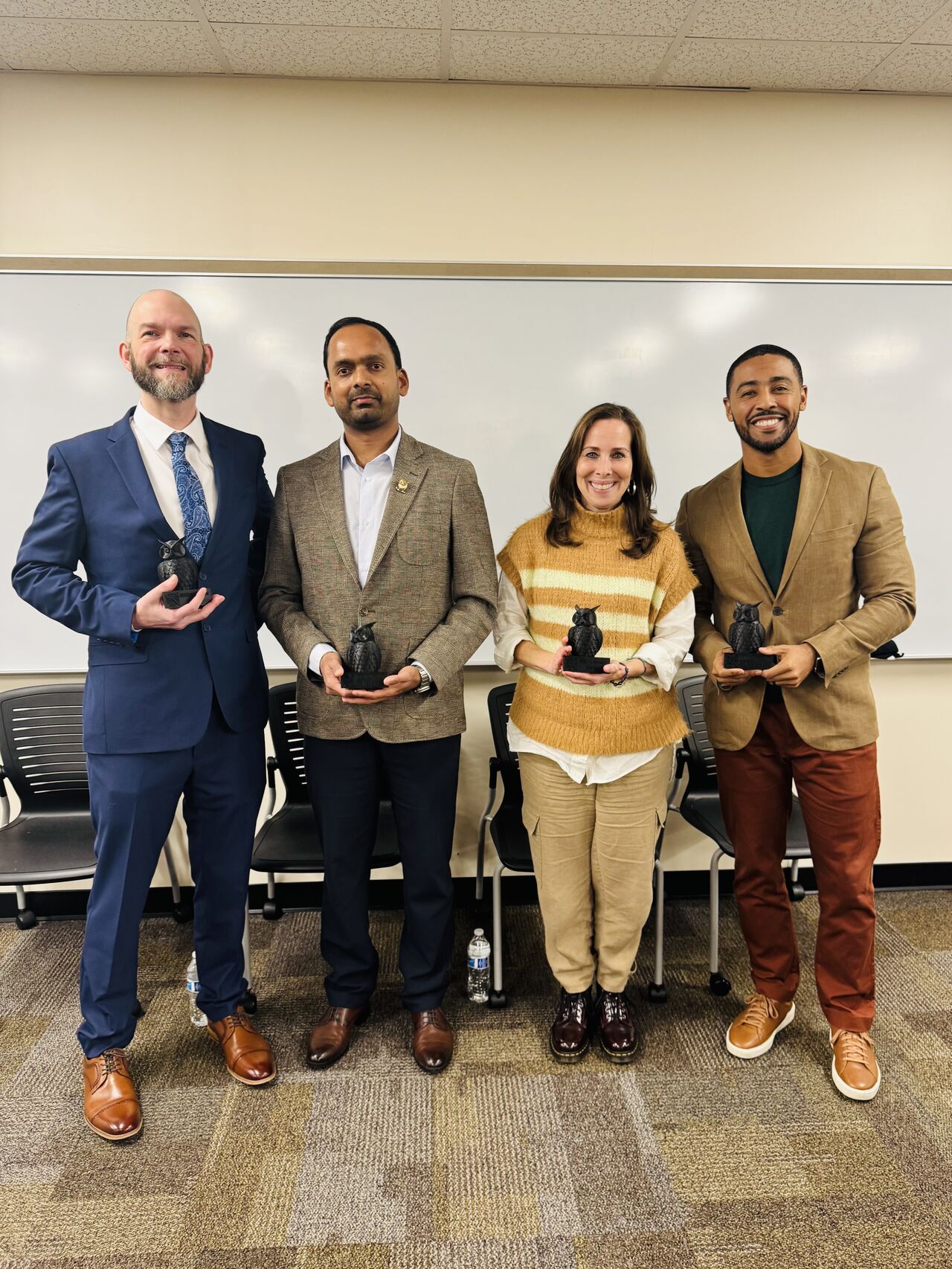
A Kennesaw State University AI Panel Reflection
The Room Where It Happened
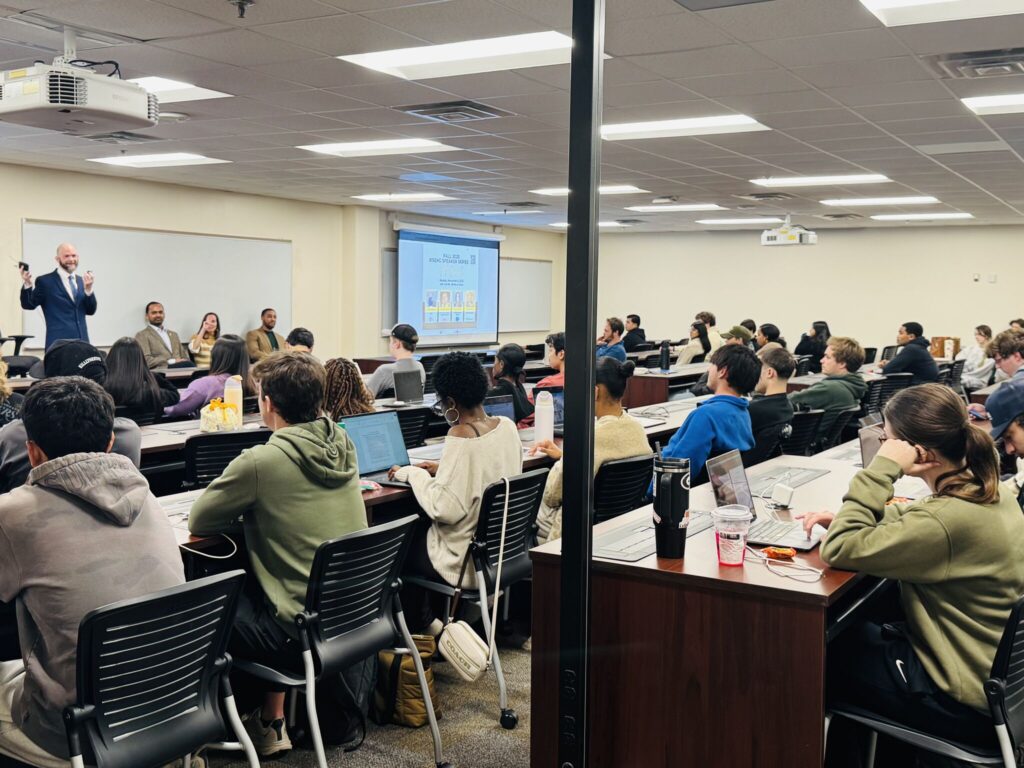
When I walked into Kennesaw State University’s classroom on November 3rd to moderate an AI panel, I expected engaged students and insightful professionals. What I didn’t expect was the palpable shift in energy as these two worlds collided—seasoned practitioners from Microsoft, Salesforce, and Fiserv meeting students who are about to enter a workforce none of us fully understand yet.
The numbers told one story: when I asked who uses AI daily, a few hands went up. Weekly? More hands. Monthly? Even more. But by the end of the evening, something had changed. In their reflections afterward, student after student wrote variations of the same realization: “I need to start using AI every day.”
The Uncomfortable Truth Nobody Wanted to Hear (But Everyone Needed To)
Sanjoosh Akkineni, Manager of Data Science & Analytics Programs at Fiserv, didn’t sugarcoat it: “AI will replace people who do not use AI.”
The room went quiet.
But then he added something that transformed fear into agency: “You are the only person that’s responsible for your career. No faculty, no family, certainly not other companies.”
One junior majoring in Finance captured the sentiment perfectly in their reflection: “Going to the AI panel was really eye-opening and made me realize how fast technology is changing… That made me realize how important it is to stay updated and keep practicing with new tools like ChatGPT, Microsoft Copilot, and Claude AI.”
The Aha Moments That Changed Perspectives
From the Panelists
Each panelist shared their “aha moment”—that instant when they realized AI wasn’t just another tech trend:
Sanjoosh described building UAnalytics at KSU, a predictive modeling system that alerted faculty when students were at risk of failing. When a faculty member reached out to say the system helped them save a student’s academic career, he realized AI’s potential to genuinely help people.
Nicole Chabrier from Salesforce remembered the shift from clicking through Google search results to simply asking a question and getting an answer. “When I actually could ask a question and get the answer without having to dig, that’s when I realized things were changing quick.”
Jemir Martinez from Microsoft recalled asking ChatGPT a complex math question in 2020 and getting an instant, accurate response. The TI-83 calculator that got him through school suddenly felt like ancient history.
From the Students
The students’ reflections revealed their own aha moments happening in real-time:
A Cybersecurity junior wrote: “Overall, I felt like the panel was pretty eye opening in terms of how much AI is used in professional environments. With how fast AI is advancing, it feels impossible to keep up… so having an idea on how to grow with AI makes it much more feasible.”
An Information Systems senior shared: “Learning about all their different ways that they personally use AI opened up a lot of options to me. You don’t know what you don’t know and they mentioned uses of AI that I never thought about.”
The Job Search Story That Changed the Game
If there was one moment that electrified the room, it was when Sanjoosh shared exactly how he used AI to land his current role at Fiserv. His strategy was methodical, brilliant, and immediately actionable.
Here’s his step-by-step framework:
STEP 1: Research Beyond the Company
→ Don’t just learn about the company
→ Specifically research the business unit and its purpose within the company
→ Understand the unique challenges that team faces
He didn’t just read about Fiserv as a whole—he dove deep into the specific business unit he was applying to, understanding its unique role, challenges, and how it contributed to the company’s mission.
STEP 2: Know Your Interviewers
→ Ask HR for the names of everyone you’ll meet (6 rounds = 6 people)
→ Find them on LinkedIn
→ Copy their entire profiles into ChatGPT
When HR provided the names of his six-round interview panel, he went straight to LinkedIn. He didn’t just glance at their profiles—he copied each person’s complete LinkedIn profile and fed it into ChatGPT to analyze their backgrounds, interests, and what they value professionally.
STEP 3: Find Authentic Connection Points
→ One interviewer had only 2 LinkedIn posts—both about underprivileged children’s education
→ Sanjoosh had volunteer experience in this exact area
→ He authentically shared this connection during the interview
This is where AI-powered research meets genuine human connection. One interviewer barely posted on LinkedIn—just two posts total, both about educational opportunities for underprivileged children. Sanjoosh had done volunteer work in this exact space. During their conversation, he naturally shared his own experience working with underserved students, creating an authentic human bond that went beyond the job requirements.
STEP 4: Write YOUR Story First
→ Don’t let AI write your cover letter from scratch
→ Write your authentic story about who you are and what you’ve accomplished
→ THEN use AI to help tailor it to each interviewer’s interests
He emphasized this point strongly: start with your truth. Write your own story—your experiences, your accomplishments, your journey. Only after you’ve captured your authentic narrative should you use AI to help you tailor that story to resonate with each specific interviewer’s background and interests.
The Result? He got the job.
The Key Insight: “You should be able to not only talk to them at the level of what the job requires, but also try to connect to them as a human being.”
Time Investment: Less than 30 minutes of AI-assisted prep for all six interview rounds.
Students took notice. Multiple cited this as their number one takeaway from the entire evening.
A Finance junior reflected: “One of the speakers mentioned how Salesforce shifted toward AI and gained a big advantage, which showed me that taking action early matters… I learned that I need to be competitive in my career to reach my goals, especially since AI is upcoming.”
An Information Systems junior wrote: “One of the speakers talked about how he used AI for his interview and he walked us through what he looked up and it was very helpful to keep in mind.”
A Senior in Information Security and Information Assurance added: “I never really thought about how I can incorporate AI to show how I can apply those prompt engineering skills as well.”
The Skills That Actually Matter (According to Those Who Hire)
AI Literacy: The New Baseline
Nicole made it crystal clear: “Just like financial literacy. You don’t need to know how Wall Street works, but you definitely need to understand how AI works.”
She emphasized that at Salesforce, the technology changes literally every single day. The company isn’t waiting for the dust to settle—they’re in the arena, breaking things, learning, adapting.
Students heard this loud and clear. A Finance and Information Systems sophomore wrote: “The panel emphasized the importance of prompt engineering—learning how to communicate with AI tools to get the best results… I plan to apply this knowledge in my coursework and future career by integrating AI into financial systems.”
Prompt Engineering: The Art of Asking Better Questions
Jemir broke down prompt engineering in terms anyone could understand: “If your input sucks, your output is gonna suck.”
He introduced the concept of frameworks: Persona (who should the AI act as?), Action (what do you want it to do?), and Output (what form should the answer take?).
The game-changer? Using audio prompts instead of typing. Students were genuinely surprised by this tip.
A junior in Information Systems reflected: “Jemir’s mention of using AI daily and practicing prompt engineering… The one I found the most interesting was when he mentioned using voice prompts as opposed to text prompts.”
Multiple students specifically cited prompt engineering as their number one takeaway from the event.
The Human Skills AI Can’t Replace
I reminded everyone: “We always need good leadership… good solid judgment… those just can’t be replaced.”
Nicole added a critical warning about emotional intelligence and avoiding AI as a therapist, sharing the story of a Google engineer who became so attached to an AI that he wanted to give it legal personhood as a sentient being.
“Loneliness is the number one disease in the world,” she said. “Please connect with humans as often as you can.”
A Sophomore in Information Systems captured the balance perfectly: “I learned that it is really important to understand Data literacy because understanding how data is being processed can give you important critical thinking skills. Also I learned that in order to continue being successful it is important to stay curious and be able to problem solve.”
The Future Is Already Here (And It’s Terrifying and Exciting in Equal Measure)
Agents: The Next Big Thing
Jemir introduced the concept of AI agents using the simplest possible metaphor—moving chairs from one place to another. An agent learns a workflow once and can then automate it infinitely.
“Now we’re getting to the point where agents can now talk to each other,” he explained. One agent completes its task, then tells another agent to start its work. An orchestration of agents, all communicating to complete complex workflows without human intervention.
A Cybersecurity sophomore noted: “I learned that for AI there are different agents for AI that are programs that can observe, reason, and act on what the user tasks it to do.”
The Disappearing App Era
Nicole predicted something bold: “I can see a world where apps go away.”
She explained how our phones live in silos—one app for calendar, another for email, another for social media. But with AI, she envisions devices where you simply have conversations and the AI manages everything behind the scenes.
“You will no longer need an app. It’s literally going to be just a conversation, audio or text.”
The Advice That Stuck (From Students’ Own Words)
Stay Curious
“Staying curious is extremely important.” — Jemir
A Junior in Information Systems wrote: “What really stuck with me was Jemir Martinez saying it is important to stay curious. This is a skill that I will apply in both my course work and future professional opportunities because you can never stop learning new things.”
Adapt or Get Left Behind
“You need to be able to adapt. Anything’s coming your way, it’s about how you react.” — Sanjoosh
A Junior in Cybersecurity reflected: “The session has highlighted how important it is to learn AI due to how it could replace my position within the next 5 years. How you must adapt with the changes that AI will bring.”
Build Personal Projects
“The biggest way to stand out to a recruiter right now is personal projects.” — Jemir
An Economics junior responded: “This event helped me because one of the speakers said something about a lab and I think this will help a lot in my personal project that I do.”
Network Relentlessly
“The person you’re sitting next to will be the person that will help you get to your next job.” — Jemir
Multiple students mentioned networking as a key takeaway. An Accounting junior wrote: “I am impressed by the level of constructive feedback and positive reinforcement received by this panel… The value of networking.”
Spend 10-15 Minutes Daily
This advice came up repeatedly from the panelists and resonated deeply with students.
An Information Security senior wrote: “I’ll definitely try to use AI everyday for 10 minutes or so like they said to do, so I can get better at leveraging AI and be more confident in getting a job.”
The Real-World Applications That Opened Eyes
Nicole’s Property Tax Appeal Win
Nicole shared how she used Google Gemini to research, understand, and successfully appeal her property tax assessment—saving herself $200 per month. She had no background in property tax law, no lawyer, just AI and determination.
The county board asked if she was a lawyer. She wasn’t. She just knew how to ask the right questions.
A Finance and Information Systems student noted: “I learned that I can copy and create better interviewing questions.” The applications were clicking.
Sanjoosh’s Job Hunt Success
We already covered this, but it bears repeating: he got the job using AI strategically while maintaining authentic human connection.
Jemir’s Daily Customer Service
Jemir described getting a customer question he had no idea how to answer. He used Copilot to craft a response, verified it with colleagues, and sent it back—all in 15 minutes.
But then he made a crucial point: “Think about that, right? They can clearly go and do that themselves… that’s where our jobs start getting…”
The implication hung in the air: if customers figure this out, what’s our role?
The Warnings Nobody Wanted to Give (But Had To)
The Privacy and Security Red Flags
The “public square rule”: If you wouldn’t share your social security number with a stranger in public, don’t put it in ChatGPT.
Sanjoosh explained that Fiserv, touching 99% of U.S. households, has strict AI and data policies. Everything goes through security reviews.
“Once you are out there, it’s out there. You can never get it back.”
The Loneliness Trap
Nicole’s warning about the Google engineer who formed an emotional attachment to AI was sobering. When people can’t connect with humans without feeling judged, they turn to technology—technology that can’t pick up on nuances or truly understand feelings.
An Information Systems senior wrote: “I really appreciate the event… I love that they gave us good information… especially the part when they warned us about attaching to AI as a person.”
The Hallucination Problem
All the panelists emphasized: AI can and does hallucinate. It will confidently give you wrong answers.
“Staying curious is extremely important,” Jemir stressed. “You knew that the answer was wrong, but think about somebody else who didn’t know that.”
A Management junior reflected: “I learned that AI is very helpful and beneficial in many ways.” But then added the critical caveat: “They explained that although AI can do a lot in my field it can no way replace what I do because AI can only do what the user tells them and if the prompt isn’t good enough it wouldn’t fully get the job done.”
What Students Are Taking Away (In Their Own Words)
The Shift in Mindset
A Sophomore in Accounting wrote: “During this meeting I have learned a bit. I was always conflicted with the usage of AI, but after today I’m going to start using it to my advantage. The world is changing and in order to keep up with it, we must implement new technology to succeed at a faster rate.”
An Entrepreneurship sophomore admitted: “I lost interest with AI because I do not use it beyond school, but I learned that I need to stay curious about AI. I am very against AI due to its impact to the planet but I guess we’re all gonna die anyways and it is taking over the world.” (That last line got dark, but it’s honest feedback about the cognitive dissonance many feel.)
The Fear Transformed into Action
A Finance junior summed it up: “You need to start getting practice with AI early and start applying it to your life… There is no stopping AI so you need to start learning how to apply it to your life now.”
An Information Systems junior wrote: “Whether people hate or love AI, AI is now becoming bigger and bigger. People and companies need to adjust and understand AI now. This event made me realize that I need to try to keep up with tech since tech is moving so fast.”
The Gratitude
Perhaps most telling were the simple expressions of appreciation:
“Really good panel. They were very informative and nice :)” — Senior, Accounting
“Wow that was life changing.” — Junior, Accounting
“It was a great event and it helps to have a deep understanding on AI.” — Junior, Information Systems
“My favorite part of this talk is hearing the evolution of AI seeing the shift from one normal area with technology to the next. It is very motivating to hear that our jobs are not completely obsolete.” — Junior, Accounting
The LinkedIn Reality Check
Multiple students mentioned LinkedIn and networking as critical takeaways. Sanjoosh was particularly emphatic: “Don’t reach out and say, oh, I see a job in your company. Can you recommend me? Trust me, nobody will respond to that.”
Instead, he advised:
- Find people in your target industry
- Engage with their content meaningfully
- Reach out about things that genuinely interest you
- Learn from them before asking for anything
A Junior in Finance wrote: “Join hackathons where you actually meet, because you are not only showing your intelligence, what you bring to the table, and also you are talking to the actual clients or the business people where you will be working eventually.”
The Tools They Should Know (But Probably Don’t)
The panelists name-dropped tool after tool:
- Lovable: Build full-stack applications with prompts (student accounts available)
- Replit: Another coding platform
- Claude: Better for coding than ChatGPT (Jemir’s preference)
- GitHub Copilot: For in-editor code assistance
- Sora: AI video generation
- Veo (Google): Even better video generation
- Microsoft Copilot: Free for students through their university accounts
- Slack with AI agents: Context-aware workplace communication
A Junior in Management noted: “I’m learning how to train my own models at home… it was still extremely informative to hear how these companies are utilizing them for professional work.”
The Honest Assessment About Jobs
Let’s not dance around it: jobs are being eliminated. The panelists were unanimous and honest about this.
But they were equally clear about the flip side: new jobs are being created in AI spaces.
Sanjoosh explained: “In those companies, they’re posting new jobs. If you look at the job website, there are new jobs coming up in the space of AI.”
The key is positioning yourself for those new opportunities, not clinging to roles that are being automated away.
A Senior in Information Systems wrote: “I learned AI skills I need to be competitive in getting a job. One person said a lot of current jobs will be gone, so we need to join ChatGPT networking brainstorming groups to keep our skill set relevant.”
The Playing Field Has Been Leveled (Whether We Like It or Not)
Nicole made perhaps the most profound observation of the night: “AI has leveled the playing field. Leaders of the largest companies, they have no clue what to do with this technology.”
This is unprecedented. Senior executives with decades of experience are learning alongside entry-level employees. The traditional hierarchy of knowledge has been disrupted.
“When you go into any kind of work environment, be curious, go with fresh eyeballs. Ask the questions. Why do we do this this way? If you ever get an answer, because we’ve always done it that way, do you know that that person and that organization is not gonna be able to move forward?”
A Junior in Finance captured this perfectly: “The speakers also talked about how AI can be leveraged to stand out in an extremely competitive job market… AI is growing at a fast rate, it is important to stay curious and adapt to the changes to stand out.”
What I’m Taking Away as the Moderator
Sitting in that room, watching seasoned professionals share hard-earned wisdom with students who are simultaneously anxious and energized about their futures, I realized something: we’re all learning this together.
The panelists don’t have all the answers. They’re figuring it out day by day, tool by tool, prompt by prompt. And that’s actually the most encouraging message we could give students.
You don’t need to know everything about AI. You need to:
- Stay curious
- Practice daily (even just 10-15 minutes)
- Build authentic human connections
- Develop your prompt engineering skills
- Create personal projects
- Network genuinely
- Adapt continuously
- Never stop asking questions
As one junior in Information Systems beautifully summarized: “I loved hearing the speakers talk about their experiences and give advice. They recommended we work within our passions, learn and be curious about AI, and to adapt to the new environments around us.”
The Last Word (From a Student Who Gets It)
I’ll leave you with this reflection from a Senior in Information Systems, who synthesized the entire evening perfectly:
“The AI Panel ISEG meeting focused on how artificial intelligence is fundamentally changing the professional landscape. Speakers emphasized that while AI is poised to automate roles like data entry and coding, the human role must shift toward collaboration and critical thinking. Nicole stressed the importance of Data Literacy—understanding data—and using critical thinking to avoid misinformation. Sanjoosh and others highlighted Prompt Engineering—the skill of crafting detailed queries to guide AI models—as crucial for future careers. Jemir introduced AI Agents, which automate complex, specific workflows much faster than humans. The overall takeaway was to embrace continuous learning, stay curious, and prioritize networking to adapt to the evolving opportunities created by these new AI tools like Gemini and Copilot.”
The future isn’t coming. It’s already here. And the students who showed up that evening? They’re ready to shape it.
About the Panel: I moderated this panel discussion with:
- Sanjoosh Akkineni, Manager of Data Science & Analytics Programs, Fiserv
- Nicole Chabrier, Strategic Customer Success, Salesforce
- Jemir Martinez, Cloud & AI Specialist, Microsoft
Special thanks to Alison Hedrick, Principal Lecturer of Information Systems, and Dr. Aaron French, Director of Engagement and Assistant Professor of Information Security & Security at Kennesaw State University, along with all the students for their engagement and honest reflections.
About the Author
Drew Pearson is the founder of XR DOJO, an Atlanta-based creative technology agency helping businesses unlock the power of extended reality, AI, and immersive storytelling. When not building the future, he’s moderating panels on AI and teaching the next generation of XR creators.